The short answer
Divide the wall width in inches by the board width plus the gap and round up for the boards; there is one batten for every gap between them. A 12 ft wall in 1x10 boards, 9-1/4 in wide, with a 1/2 in gap takes 144 / 9.75 = 15 boards and 14 battens. A 1x3 batten then covers each board by 1 in, more than the 1/2 in the Western Red Cedar Lumber Association asks for on 6 in boards.
A board and batten wall is wide vertical boards with a small gap between them and a narrow batten nailed over every gap. The count is simple arithmetic, but the gap, the batten width and the nailing all have to agree, or the battens will not cover the boards when they shrink. Enter one wall at a time below.
Calculator
Board and batten calculator
Siding: wide boards with a gap, a batten over every gap. Accent wall: battens only, spaced evenly on a flat wall. Enter one wall at a time.
Siding: boards = wall width / (board width + gap), rounded up; one batten over each gap between boards. The batten overlaps each board by (batten width - gap) / 2; Real Cedar asks for at least 1/2 in on 6 in boards and more, in proportion, on wider ones. Nails: one per bearing through the center of boards under 8 in, two per bearing 2-1/2 to 3 in apart on wider boards, and one per bearing through each batten, in the gap. Accent wall: the battens are spaced so every gap is equal, ends included. Prices: shelf prices read at Home Depot stores, each with its store and date under the result, before tax. A price shows only for the lengths we read, and species and grade change the price, so check yours at your yard.
How to Calculate Board and Batten
The boards
Divide the wall width in inches by the board width plus the gap, and round up. A 1x10 board is 9-1/4 in wide, so with a 1/2 in gap each board takes 9-3/4 in of wall. A 12 ft wall is 144 in, and 144 / 9.75 = 14.8, so 15 boards. The boards are as long as the wall is tall, so an 8 ft wall takes 8 ft boards.
The battens
There is one batten over each gap, so one fewer than the boards: 14 on the 12 ft wall. The corners take corner boards or trim instead, which are not in this count.
The overlap
Each batten covers the two boards beside it by half of what is left after the gap: (batten width - gap) / 2. A 1x3 is 2-1/2 in wide, so over a 1/2 in gap it covers each board by 1 in. The Western Red Cedar Lumber Association asks for at least 1/2 in on nominal 6 in boards spaced 1/2 in apart, and proportionally more on wider boards. The calculator reads that as 1/2 in times the nominal board width over 6: 5/6 in for 1x10 and 1 in for 1x12.
| Boards | Battens | Gap | Overlap each side | Enough? |
|---|---|---|---|---|
| 1x6 | 1x2 | 1/2 in | 1/2 in | Yes, the minimum |
| 1x8 | 1x2 | 1/2 in | 1/2 in | No, 2/3 in wanted |
| 1x8 | 1x3 | 1/2 in | 1 in | Yes |
| 1x10 | 1x3 | 1/2 in | 1 in | Yes |
| 1x12 | 1x3 | 1/2 in | 1 in | Yes, the minimum |
| 1x12 | 1x3 | 3/4 in | 7/8 in | No, 1 in wanted |
Worked example: a 12 ft shed wall
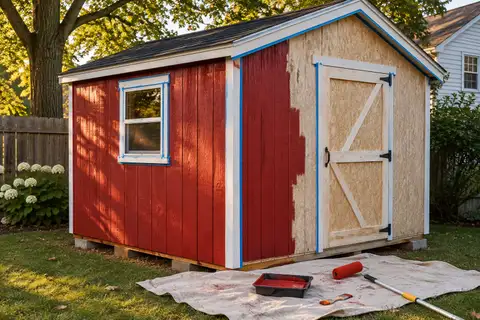
Take a 12 ft wall, 8 ft tall, in 1x10 boards with 1x3 battens and a 1/2 in gap.
- Boards: 144 / (9.25 + 0.5) = 14.8, so 15 boards of 8 ft.
- Battens: 15 - 1 = 14 battens of 8 ft.
- With 10% extra: 17 boards and 16 battens.
- Nails, with blocking rows 24 in apart (5 rows on an 8 ft wall): 15 boards x 5 x 2 = 150, and 14 battens x 5 = 70.
Board and Batten Spacing on an Accent Wall
Indoors, board and batten usually means battens alone on a flat wall, with no boards behind them. The aim is equal gaps, with a batten at each end. Divide the wall width less one batten by the gap you want plus one batten, round to the nearest whole number, and add one; then work out the exact gap.
| Wall | Battens | Gap you want | Battens | Exact gap |
|---|---|---|---|---|
| 10 ft | 1x3 | 12 in | 9 | 12-3/16 in |
| 12 ft | 1x4 | 16 in | 8 | 16-9/16 in |
Most accent walls also have a top rail, and some a middle one. Add those as one length each.
Nailing Board and Batten
Vertical boards need something horizontal to nail to. The Western Red Cedar Lumber Association says siding should be nailed to horizontal blocking lines or to furring strips. On a shed framed with studs at 16 in, that means rows of 2x4 blocking between the studs, or furring strips across them, or a sheathing layer. The calculator counts one bearing for each row of blocking, at the spacing you enter; we start at 24 in, which is our choice, not the association’s.
Then nail so the boards can move:
- Boards under 8 in: one nail per bearing, in the center of the board.
- Boards 8 in and wider: two nails per bearing, 2-1/2 to 3 in apart.
- Battens: one nail per bearing, through the gap between the boards, so it does not pin either board.
Use the nail type and length your siding’s maker or your yard names for the species.
Board and Batten on a Shed
The shed designer counts panel siding, T1-11 or a smart panel that nails straight to the studs, and its walls have no sheathing layer. If you choose board and batten instead, add the blocking or furring, then size each wall here: the long walls, the end walls, and the gable triangle above each end, which you enter as the height above the wall. A 10 ft end wall 8 ft tall with a 2.5 ft gable takes 17 boards and 16 battens with 10% extra. For the other kinds of siding and what they need behind them, see shed siding, and for the studs behind the blocking, the stud calculator.
Check before you cut
What the lumber costs at The Home Depot
The calculator prices the lengths we read at The Home Depot: a primed finger-joint 1x10 board, 8 ft, was $27.00 at the Hamilton Mill store on Oct 13, 2026, and a primed finger-joint 1x3 batten, 8 ft, was $7.98 there on Nov 6, 2026. The 10 ft end wall above, with 17 boards and 16 battens, comes to $459.00 for the boards and $127.68 for the battens, $586.68 in all, before tax. Board and batten lumber runs from rough-sawn pine to clear cedar, and the price changes more with the grade than with the size, so for another species take the counts and linear feet from the calculator to your yard and ask for its price.
Sources
Every number in this guide that does not come from our own shed designer was checked against these 1 documents, numbered in the order the text first cites them and read on Nov 7, 2026. 1 is a code, agency, maker or store.
- 1Western Red Cedar Lumber Association (Real Cedar)Installing Board and Batten Western Red Cedar Siding