The short answer
Shed gutters run along the eaves only: two runs on a gable shed and one on a lean-to. On the designer's default 8x10 gable, each eave fascia is 10 ft long, so you need two 10 ft runs, one downspout each and a way to carry the water away from the floor.
Shed gutters catch the water that runs off the roof and send it somewhere useful instead of onto the ground right beside the floor. On a small building that sounds like a detail, but a shed roof drops all of its water along one or two short lines, and that is where splash rots siding, washes out gravel and turns the doorway into mud. This guide covers which shed gutters fit, how many feet you need on the sheds our designer draws, and how to hang them on the fascia.
Gutters go on the eaves, so the roof you design decides the job. Open the shed designer to see where your eaves are and how long they run.
Where shed gutters go
A gutter hangs along an eave, the low edge of a roof plane, where water leaves the roof. It never goes along the rake, the sloped edge of a gable.
Gable sheds: two runs
A gable roof has two planes and two eaves, one on each long wall. On the designer’s default 8x10 gable, the eaves run along the 10 ft walls, so each fascia board is 120 inches long. That means two gutter runs of 10 ft, one per side.
Lean-to sheds: one run
A lean-to has one roof plane and one low edge, so it needs a single run along the back. The lean-to is also the easy case for water collection, because all of the roof drains to one place. Our lean-to shed guide covers the roof itself.
Which way the water goes
Decide where each downspout drops before you buy. A downspout at the back corner, away from the door, keeps the entrance dry. On a gable shed you can run both gutters to the same end so both downspouts land on one side.
| Shed | Eaves | Gutter runs | Typical downspouts |
|---|---|---|---|
| 8x10 gable (designer default) | 2 x 10 ft | 2 x 10 ft | 2 |
| 12x16 gable | 2 x 16 ft | 2 x 16 ft | 2 |
| Lean-to | 1 | 1 | 1 |
Do you need gutters on a shed?
Plenty of sheds have none. Whether yours needs them depends on the site, not the shed.
When you can skip them
A shed on a well drained gravel pad, with an overhang that throws drips clear of the siding, on a spot where water soaks away fast, often does fine without gutters. The gravel takes the splash and drains it.
When gutters earn their place
Fit gutters when the drip line lands on a door, a path or a patio, when it splashes back onto low siding, when it drains toward a neighbor, or when the soil around the shed stays wet. They are also the start of any rain barrel setup.
What the code says for houses
The 2021 International Residential Code, Section R801.3, requires a controlled way to discharge roof water “not less than 5 feet (1524 mm) from foundation walls or to an approved drainage system”, but only for dwellings in areas where expansive or collapsible soils are known to exist (ICC, 2021 IRC, read November 2026). A shed is not a dwelling, and how any rule applies to an accessory building varies by jurisdiction. The idea is still a good target: land the water a few feet from the shed, not at the base of the wall. Check with your building department and our shed permits guide if you are unsure.
Types of shed gutters
There are two size classes and three common materials. The size is about how much water and how much fascia you have. The material is about strength and life span.
Mini gutters
Mini gutter systems are sold for sheds, greenhouses, playhouses and small outbuildings. They are narrow, light and clip to a thin fascia or even to the top of the siding. They suit a small roof. A large or steep roof can overflow them in a downpour, so read the roof area each system is sold for.
Full size K-style gutters
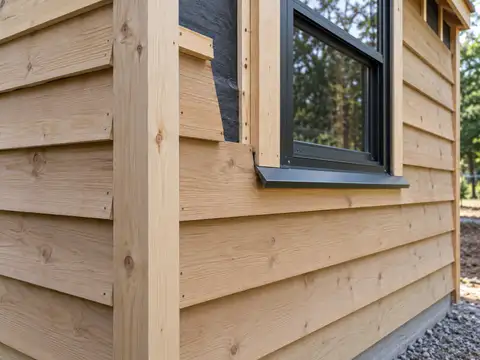
The K-style gutter used on houses fits a shed with a real fascia board. It carries more water, it is stiffer, and parts are easy to find. On the designer’s sheds the fascia is a 1x6, which is 5-1/2 inches of face for the hangers.
Half round gutters
Half round gutters look more traditional and suit a cottage or potting shed. They need their own hangers and usually cost more than K-style.
Vinyl, aluminum or steel
Vinyl is light, does not rust and cuts with a fine saw, but it can crack in hard cold and sag under snow. Aluminum is light and stiff and does not rust, which is why it is the common house gutter. Galvanized steel is the strongest and the best under heavy snow and ladders, and it is heavier to hang.
| Type | Best for | Watch for |
|---|---|---|
| Vinyl mini | Small sheds, easy DIY | Cold cracking, sag |
| Aluminum K-style | Most sheds with a fascia | Dents |
| Galvanized steel | Snow, hard use | Weight, rust at cuts |
| Half round | Looks | Price, special hangers |
What you need
For each run you will need a length of gutter, an end cap at the closed end, an outlet or drop at the downspout end, hangers, a downspout with elbows, and sealant made for gutters. Buy one hanger for every couple of feet, or whatever the gutter maker specifies, and add more where snow loads are heavy.
Fascia first
A gutter needs something solid to hang on. The designer puts a 1x6 fascia on each eave over the rafter tails. If your shed has no fascia, add one before the gutter, fixed into every rafter end. Our shed rafters guide shows the tail and the overhang.
Drip edge and the roof edge
The drip edge on the eave should lap into the gutter, so water that runs down the roof falls into it and not behind it. If the drip edge stops short, a strip of gutter apron fills the gap. Our guide to building a shed roof covers drip edge order.
Check before you cut
Overhang matters
The designer draws a 6 inch overhang on the default 8x10 gable. That is enough to hang a gutter clear of the siding. On a roof with almost no overhang, the gutter sits tight to the wall and splash still reaches the siding.
How to install gutters on a shed
The steps below work for a K-style or a mini system. Follow the maker’s instructions where they differ, especially on hanger spacing and slope.
Step 1: mark the slope
A gutter has to fall toward its outlet. Snap a chalk line along the fascia from the high end to the low end, using the fall the gutter maker gives. On a 10 ft run the drop is small, but without it water stands in the gutter.
Step 2: fix the hangers
Screw hangers to the fascia along the line, into the rafter tails where you can. Keep the back of the gutter just under the drip edge.
Step 3: cut and fit the gutter
Cut the gutter to length, fit the end cap at the high end and the outlet at the low end, and seal both joints. On a run longer than one stock length, join pieces with a connector and seal it, and keep joints away from the outlet.
Step 4: hang it and test
Snap or screw the gutter into the hangers. Pour a bucket of water into the high end and watch it run to the outlet. If water stands, adjust the hangers.
Step 5: downspout and discharge
Fit the downspout to the outlet with elbows so it hugs the corner trim. At the bottom, add an elbow and a splash block or an extension that sends water a few feet away from the shed, or run it into a rain barrel with an overflow pointed away from the floor.
Gutters and snow
In snow country, gutters take a beating. Snow sliding off a steep roof can tear a light gutter off its hangers.
Pitch and slide
The designer draws gable roofs from 4/12 to 6/12 and lean-to roofs from 2/12 to 4/12. A steeper roof sheds snow faster, which is good for the roof and hard on the gutter. Metal roofs shed snow fastest of all.
What helps
Use aluminum or steel, add hangers, and set the gutter a little lower under the roof edge so sliding snow clears it. In the heaviest snow areas some builders leave the gutters off and rely on a wide gravel drip strip instead. Our shed roof pitch guide covers how pitch and snow load work together.
Keep shed gutters working
A gutter that is full of leaves is worse than no gutter, because it overflows right at the wall it was meant to protect.
Clean them twice a year
Clear the gutters in late spring and again after the leaves fall. On a shed you can reach the eave from a short ladder, so it takes minutes. Flush each run with a hose and check that water reaches the outlet.
Guards on a shed under trees
If the shed sits under trees, a mesh guard over the gutter keeps most leaves out. Pick one that fits your gutter size, and still check it each season, because fine debris builds up on top of the mesh.
Check the hangers and the slope
After a winter, look along each run. A sag means a loose hanger or a bent one. Refix it into the fascia and pour water again to confirm the fall.
Watch the discharge
The end of the downspout is where problems show first. If the ground there stays soft or the gravel washes out, extend the downspout or add a splash block so the water lands farther from the floor. On a raised shed, that splash is also what soaks the bottom of any shed skirting.
Common shed gutter mistakes
No fall
A dead level gutter holds water, freezes in winter and rusts or sags faster. Always set a slope toward the outlet.
Gutter behind the drip edge
If the drip edge sends water behind the gutter, the fascia rots. The drip edge laps into the gutter, never behind it.
Dumping water at the corner
A downspout that ends at the base of the wall just moves the problem to one spot. Carry the water away from the shed.
Plan the roof with the gutter in mind
The eave length and the overhang come from your roof, so plan them together. Set the size and pitch in the shed designer, or start from a drawing like the 12x16 gable shed plans, and read the eave length off the plan. The designer does not draw or price gutters, so add them to your shopping list yourself. Then head back to how to build a shed for the rest of the build order.